Wednesday, August 11, 2010

Design @ Nine - Stacie Chavez

Many words come to mind when Stacie is mentioned, but the biggest one that outshines all the rest is “Sister”. We began our jewelry journey together when we started a small jewelry production company in the early 2000’s appropriately called Sisters, Inc. We later ended up here, with our then neighbor, Jay King & Desert Rose Trading. We don’t have titles at DRT so it’s difficult to explain everything each of us does –
Even though she is my sister, I look to this woman in ways that go way beyond family. You will never find her without a phone in hand or ear – we tease her about this – but often she has a few lines open at once trying to arrange a huge shipment of stones from a miner in Chile to a processor in Arizona to our manufacturer overseas. Like a Hindu goddess of the now, she is a communications expert, jewelry designer & master of the business. When you see a sparkle in a design you can be sure that Miss Stacie put it there. But Stacie can tell you what’s what, herself:

Stacie on the travel in Hawaii
I have loved jewelry and accessories for all of my life, so it is fair to say that I have my “dream” job. I found my love of being a rock hound at a very early age. I was blessed with an incredible Grandfather and Father that loved to go out and rock hunt. We would stop along any country road and turn over rocks for hours – I actually saw my first rattle snake on one of those trips. My love for jewelry and designing also came from my Grandfather. He had a lapidary shop set up in his garage and every Birthday and Christmas we would get some unique piece of jewelry that he had made especially for us. I still can remember the smell of the water when it hit the grinding stone. I would sit with him for hours out in his garage while he cut and polished stones. I believe that is where my love of stones evolved from. I still kick myself for not taking geology in college – I think I would have been a natural at.
Grandpa's handmade turquoise rings & a polished agate.
I have been with Desert Rose team for almost 7 years. We have a very unique group of people and I think it is safe to say we are one great big family. I get to work with some incredibly talented people on a daily basis and I cannot believe how we each in turn elevate one another to new levels.

Working with Jay over the years has been an incredible journey. I have been blessed with having had the experience to travel and learn from the man and the master. He has shown me some amazing places and I am truly thankful and grateful for getting to do what I do on a daily basis.
I am very lucky that I landed in the Southwest and get to be where I am – I traveled all the way from Maine to make my way to this time and space.

Smith & Wesson

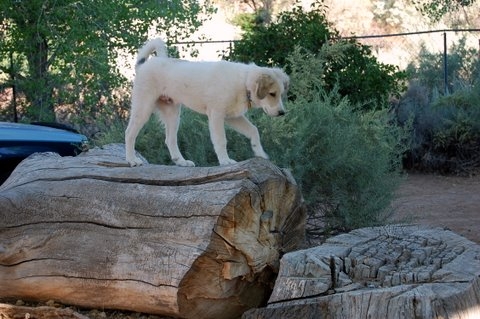
"King of the Log!"
I have two sons in college, so it has been lonely at home – so I have filled a couple of extra spaces with two Great Pyrenees puppies, “Smith” and “Wesson”. I don’t know if it is because I am older or because I am more mature – yea right – but I have enjoyed these two big dogs beyond belief – I am so in love with the two “big guys” – I can hardly stand it.

Thank you for supporting us!

Stacie with Mr. Dooley - a baby Alpaca.
The Farm Family
Miss Leila - the cutie pie butterball Alapaca.

Friday, August 6, 2010

Can You Dig? Flowering Tube Onyx

Earlier this week, someone asked me "What is Tube Onyx?" - and honestly I had no idea. So, I did a little research & here's what I found:

Tube Onyx
Country of Origin – U.S.A. (Utah)

Onyx was a common term in the TAG area and the Ozarks during the 19th and early 20th century. It was used for certain kinds of calcite or flowstone which are banded, similar to true onyx. The true onyx is also banded, and looks very similar, so the main difference is; onyx is composed of quartz, cave onyx is composed of calcite, so needless to say cave onyx is a softer stone.

The calcite concentrations in caves are banded as they are deposited very slowly, layer by layer. These are referred to as speleothems. The color depends on the climate outside, which changes continually, and the amount of pigments like iron oxide brought in by the water. So they have typically brown, beige, white and transparent banding. Much rarer are other colors like blue and green, which are typically based on copper oxides.

Flowstones are composed of sheet like deposits of calcite formed where water flows down the walls or along the floors of a cave. They are typically found in "solution” or limestone caves. However, they may form in any type of cave where mineral rich water enters.


Flowering Tube Onyx Unpolished - photo from Yuku


Flowing films of water that move along floors or down positive-sloping cave walls build up layers of calcium carbonate (calcite), aragonite, gypsum, or other cave minerals. These minerals are dissolved in the water and are deposited when the water loses its dissolved carbon dioxide through the mechanism of agitation, meaning it can no longer hold the minerals in solution. The flowstone forms when thin layers of these deposits build on each other, sometimes becoming rounder as the deposit gets thicker. There are two common forms of Flowstones, Tufa and Travertine. Tufa is usually formed via the precipitation of calcium carbonate and is spongy or porous in nature. Travertine is a calcium carbonate deposit often formed in creeks or rivers its nature is laminated and oftentimes includes such structures as stalagmites and stalactites.

The deposits may grade into thin sheets called "draperies" or "curtains" where they go over overhanging portions of the wall. Some draperies are translucent, and some have brown and beige layers that look much like “cave bacon”.


Polished Tube Onyx Cab - photo from Flicker

As in interesting note: Though flowstones are among the largest of speleothems, they can still be damaged by a single touch. The oil from human fingers causes the water to avoid the area, which then dries out. Flowstones are also good identifiers of periods of past droughts, since they need some form of water to precipitate, the lack of that water for long periods of time can leave traces in the rock record via flowstones. (most of this information came from Wikkipedia.com)

Tips of the Trade: Jewelry Care – “The Dreaded Tarnish”

Last week I received a letter from a customer who was concerned that the silver was “flaking” off her earrings. I asked her to send the pair to us so we could see what was happening with them. When we received the earrings I was relieved to find that the “flaking” was only oxidation - otherwise known as “the dreaded tarnish”. When silver meets oxygen it reacts. This reaction can be seen on the surface of the silver that expresses a darker color – it could be yellow to black.

Center Left - Shiny Silver..........Center Right - Tarnished Silver
I think that is one of the best things about silver – you can clean it and it always looks as good as new. So here are a few tips in preserving your shiny silver and avoiding “the dreaded tarnish”:


~Never dip your DRT jewelry – especially if it has stone. The chemicals can dull or even destroy your stones.
~Before & after wearing your pieces make sure to wipe them with a jewelry cloth.
~Store your pieces in an air tight bag or in a tarnish fighting jewelry case.
~Never wear your jewelry in the pool, while bathing or primping or while you’re cleaning. There are harsh chemicals out there just waiting to get the chance to put the dull on your fabulous pieces.

Just so you know, the reason why I had her send the jewelry to me was much to my concern this meant that she thought we plated our jewelry when she said “flaking” – on the contrary. All of our jewelry is made of fine, .925 silver which hasn’t been plated nor surfaced in any way.

Thursday, August 5, 2010

Design @ Nine - Jill Erickson

Well, since I am the writer of the blog and most of our content and direct contact with the outside world here at www.desertrosedirect.com I guess I should introduce myself first – I’m Jill Erickson. I started with Desert Rose Trading over six years ago. Before here, I was one of those” lifers” in school. I studied everything from creative writing to biological anthropology and ended up with an arts degree– even now I’m thinking that I would like to study mechanical engineering (it never stops). During my last semester at school, jewelry appeared to me to be a great idea for Christmas gifts – I trying to give something to everyone & so I taught myself how to wire wrap. Needless to say, I was hooked! Since then I’ve taught myself to fabricate and create one of a kind pieces. Some of which have been incorporated into the long list of designs here at DRT.


When I create I think of the women close to me & imagine what they may like – my mother, who I love making jewelry for, loves everything, so with her it’s an easy match. I don’t blame her for adoring it all – she’s right – everything is beautiful. From turquoise to jasper to agates I can keep on opening up books or bags of rough and find something that I haven’t seen or known before. Every day really is an adventure here.

Usually I’m the girl behind the scenes, so…

This is me on a good day.
This is my favorite stone today - Maroon Birds Eye Rholite.  My favorite changes often!
I grew up & live in New Mexico.  The mountains (esp The Sandia's), big skies and a forever horizon just to the west always feels like home.

Wednesday, August 4, 2010

Can you Dig? Geodes

After creating a weekly deal with our geode pendants & getting the chance to look at all these fantastic stone pendants, I wanted to take a moment to emphasize how truly unique this find is. Our geodes came from Mexico where we have worked closely with the miner for years on many projects. These small orbs are handpicked, sized and sorted. Each formed in an ocean floor volcano, which is now in Chihuahua, Mexico. Rarely are there ever two alike & why would you want them to be? With either or both crystal formations or addition of agate bands, the color range from white, to pinks, to red or light blue – maybe even black. I’m truly smitten. Can you tell?

In Tucson during the gem & mineral show companies haul in giant cathedral geodes - here are a few that are still in crates - these happen to be amethyst.

Smaller geodes can be "barreled" - the shelf in the background holds cut and polished agate geodes that can be used as home decor.

Here are a few more of the larger geodes - at this show there was a geode the size of a small truck, really, that was placed at the doors. We took pictures but apparently didn't archive them well. Ooops!

While I was looking up info on these pendants I ran across some info regarding how they are formed which is pretty interesting stuff. There are two theory’s on how these orbs are formed. One is formed in Lava & the other is formed in Dolomite. Since there is no easy way to explain how they are formed, here is a thorough explanation I picked up from ehow.com that I found to be quite interesting:


While experts don't know for certain how geodes are actually formed, there are theories among geologists about the processes that take place. There are generally two types of geodes. One geode is made out of lava. The other is made from dolomite, a limestone-like sedimentary rock. Each geode is created through different processes. All geodes, no matter how they are formed, must contain hollow bodies in which crystals can form.

Some geodes are formed out of molten lava rocks. After the molten rocks cool, they create gasses that, when dissolved, turn into bubbles. These bubbles turn into cavities once the rocks harden. The early stages of these cavities are called thunder eggs. According to experts, the minerals that form into crystals may have flowed into these cavities in two ways. Either the minerals could have come from the hot water flowing through the cracks in the lava rocks as they cooled, or they could have been deposited much later as mineral groundwater. However the convention minerals such as quartz are introduced into the thunder egg through a flow of water, thus creating the opportunity for crystals to form.

The formation of geodes from dolomite is much more complicated that those formed out of lava rocks. The theory of how dolomite geodes are formed came from geologist Robert Maliva in 1987. His theory goes that the geode cavity formed from a small, hard spheroid that later dissolved and became a cavity, a process that began over 350 million years ago in the warm, shallow waters that once covered what is now the central United States region. Lime sediments grew in the warm saltwater. When the saltwater interacted with sediments rich in calcite, the calcite metastasized into the minerals dolomite and anhydrite.

The anhydrite then turned into hard spheroid bodies inside the dolomite. Meanwhile, the dolomite changed from sediment into a hard rock. Anhydrite will dissolve even in the slightest amounts of acid in water. Thus, after acidic water was introduced, outer areas of the anhydrite broke away and were replaced with quartz, which were in the beginning only small fibers of crystal. The centers of the anhydrite bodies were then dispersed completely. Quartz was fed through the rock from water rich with minerals, forming the crystals that grow inside. Over time, the rocks disintegrated, leaving the dolomite to open the elements and causing it to dissolve. The hardened quartz then separated from the dolomite, turning into geodes formed on the ground.